Map current-state social and work processes
OpenDecide starts at team level, the primary engine of performance. A short, science-based questionnaire produces a factual baseline the team recognizes as its own.
Focus on team functioning, not people
The scan measures the process the team operates inside: objectives, roles, stakeholder collaboration, innovation, information flow, rituals, and never individual performance. Nobody is being graded, which is exactly why people answer honestly.
Only science-based, validated questions
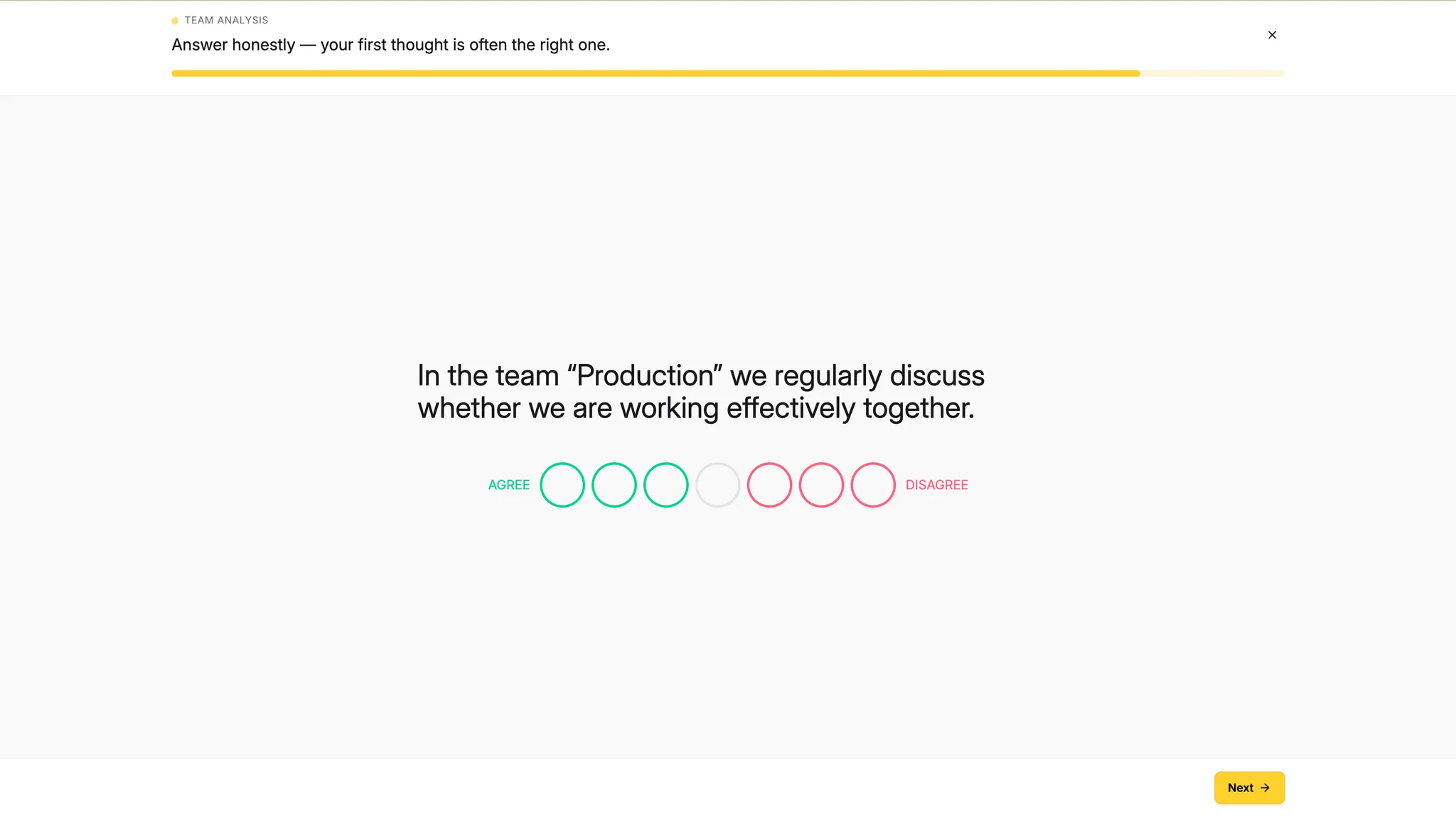
Every item comes from peer-reviewed research on team effectiveness and is psychometrically validated. What you measure is what the literature shows actually drives performance.
12 minutes, agree or disagree
One pass through the questionnaire takes twelve minutes. Each statement is answered on a simple agree/disagree scale, so cognitive load stays low and completion rates stay high.
International by design
The questionnaire is available in English, French, German, Spanish, Italian, and Chinese, so multinational teams read the same diagnosis in their own language.
Reminders only to those who haven't answered
Follow-ups go exclusively to people still pending. Those who already answered are never chased again, and the manager never has to run after anyone.
Identify waste and bottlenecks on the journey to top performance
The scan becomes a diagnosis: where the team loses energy, where consensus breaks down, and which factor to work on first, explained in plain language, for everyone who took part.
A clear view of your team trajectory and what's missing
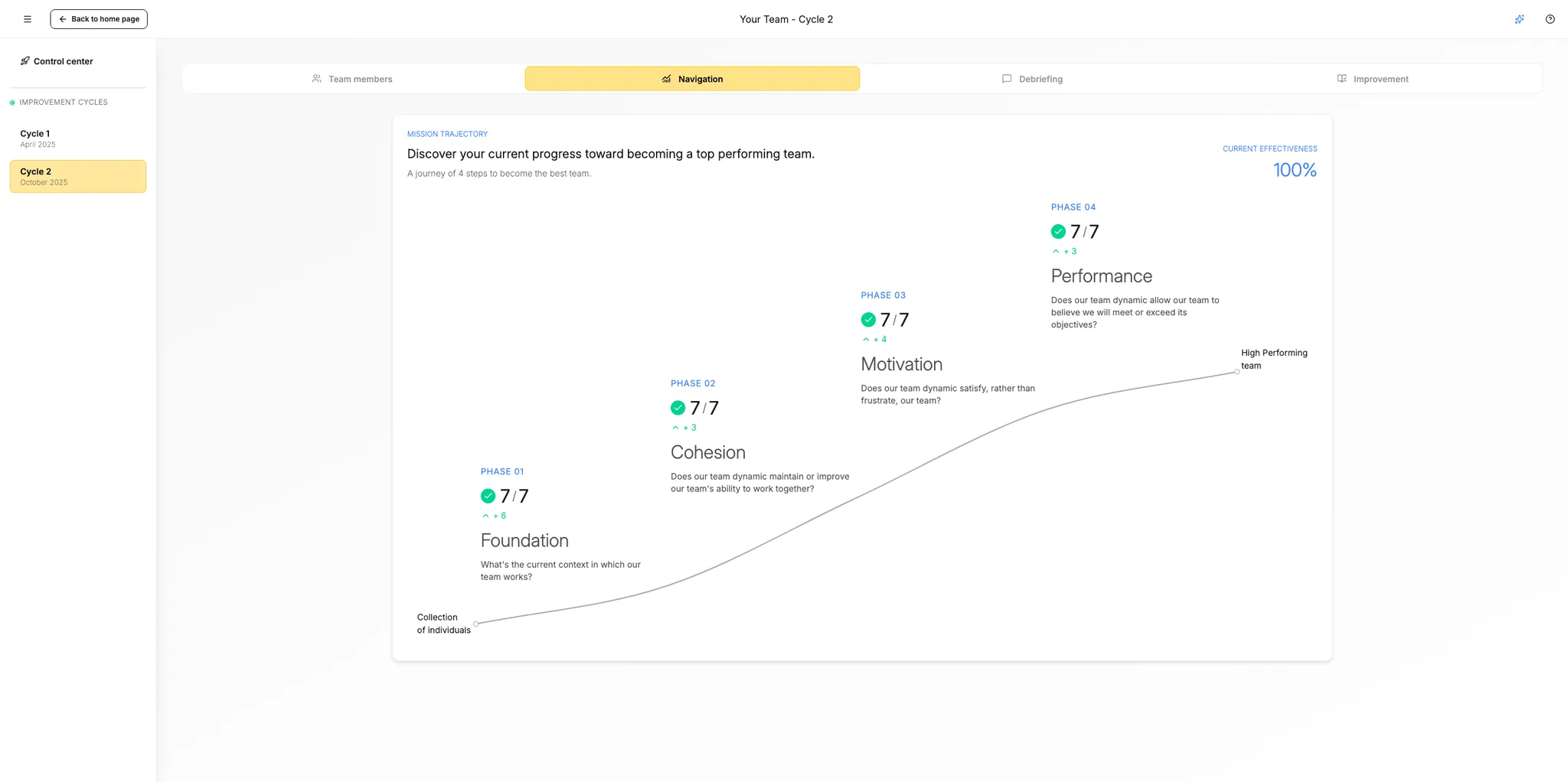
See at a glance how close the team is to top performance and which factors are still holding it back, in one overview that replaces reading through every result one by one.
Speak with the AI assistant to explore your team data in natural language
Ask questions in natural language, the way you would ask an expert. The assistant answers from your team's own results and shows the factors and figures behind every answer, so nothing is a black box.
Team members have a divergent view on this factor, indicating different experiences of it.
Spot which factor is missing consensus within the team
Two teams with the same average can be in completely different situations. OpenDecide surfaces the factors where answers diverge, the silent disagreements that block execution long before anyone names them.
Objectives are known but not sequenced. The team can name the year's targets and still disagree on what matters this month, which is why arbitration keeps escalating.
Get a contextualized interpretation for each factor
Each factor comes with a reading written for your team's actual situation, not a generic benchmark comment. You know what the score means, and what it implies for the work.
Accessible to all team members, not only the manager
Everyone who answered can open and explore the results. The diagnosis becomes a shared object the team discusses together, instead of a report that lives with one person.
Manage continuous improvement over time
One scan is a photograph; repeated cycles are a trajectory. The platform keeps that trajectory readable even as the team's composition and context change around it.
Monitor the evolution of your team
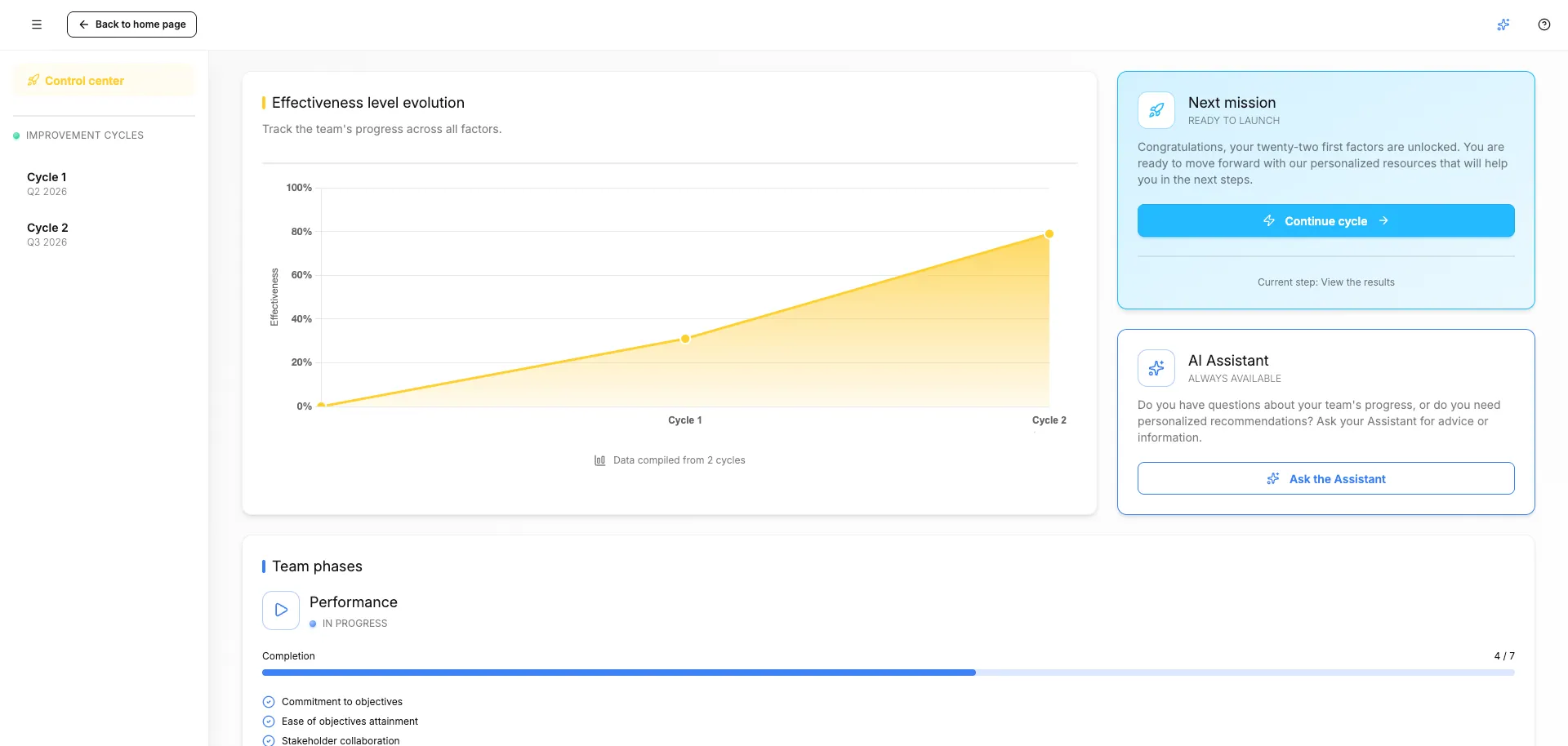
One view tracks effectiveness cycle after cycle, so the team always knows where it stands and whether the last round of changes actually moved the needle.
Track the evolution of the team composition versus team effectiveness
Arrivals, departures and reorganizations are tracked alongside effectiveness, so you can tell whether a move in the score reflects real progress, a regression, or simply a team that is no longer the same team.
See what's next in an instant
The platform surfaces the priority action for the coming cycle, so the team never closes a scan wondering what to work on next.
Manage your cycles and launch a new one in one click
Cycles are run from the platform. When the team is ready, relaunch a scan in a single click: no setup, no new project to open.
Speak with the AI assistant on the evolution of your team across time and context
Question the evolution of your team across cycles and contexts, and get an answer that accounts for what actually changed between them.